
'It's strange to me that the LinkedIn algorithm is prioritizing silly, personal posts, while practically blocking some professional content.'
That was the start of a post Gage Mitchell wrote a couple of weeks ago on LinkedIn (featured with his permission). His frustration seeping through his words that his well-thought-out professional content gets ignored while fluff posts get seen.
I felt his pain. And I wanted to help because I totally get it. Heck, I’m sure you get it. How many times have we posted something on social media (this isn’t limited to LinkedIn) that could help change our next client’s life, only to have a ‘silly, personal’ post, hog the spotlight - 100s of comments, 1000s of views?
While our post? 51 views, 2 comments - one from our mother, the other from our current client.
It’s infuriating, isn’t it?
But here's the thing we all miss (or forget).
It's NOT the algorithm's fault.
The algorithms are simply codes set up to show content and people we normally engage with (+ ads), so that we stay on the platform as long as possible. Which means if most of the content really being seen is ‘silly, personal posts,’ it's because of the number of 'silly' comments being dropped on it.
So, why are so many people engaging with silly, personal posts?
Because they are EASY for ANYONE to relate to.
While our professional stuff?
That’s only meant for OUR people - the ones we want to talk to (usually our ideal client). Which is a much much SMALLER pool of people. Many of who also happen to be lurkers, the people quietly consuming until ready to say ‘I’ve been reading your content…’ Which means LESS engagement (and visibility) on our professional content.
But one BIG thing we’ve forgotten while we’re so focused on what the algorithm is doing (or not doing) is that WE could (and can) be doing things differently.
I promised Gage a much better answer than LinkedIn's 1,100-character limit would allow me. So, I'm answering both him and anyone feeling the same frustration here.
What most of us don’t realize is…
Comments ARE conversations.
It's so easy to blame the algorithms these days. It’s actually the most common excuse for why our content (AKA we) aren’t getting seen on social media. It’s because we've been trained by the platforms to think ‘comment + engagement = conversions.’ Conversions as in number of likes, views, comments, and shares.
NOT comments are actual conversations with an actual human being that could potentially become our next client or invite to speak on our favorite podcast. Or that commenting actually increases the reach of your content. And they give you 100% reach with the right people.
So, now we’re just ticking boxes, instead of building relationships.
Did I comment on 10 posts today?
Yes.
Done. ✔️
And now what almost everyone forgets is that we don't have to wait for an algorithm to have a conversation with someone.
Yep, we can 100% intentionally pick a person and start a conversation, whether it's in the comments on their content (easy peasy since we already have a conversation starter) or we can even send them a DM. Of course, that doesn’t mean saying just anything. The quality of our comments matters when it comes to building relationships.
Gage is an excellent example of what I mean quality counts.
If you want more no-nonsense strategies like this, including real-time tips and insider advice on building relationships online, subscribe to my Substack newsletter where I share deep dives and fresh ideas every week.
Meet Gage: Why Many Comments Don’t Convert
Let me introduce you to Gage Mitchell. I met Gage when a good friend commented on his content and our evil villain…the algorithm…dropped his post with her comment on it into my feed.
Gage is doing what so many of us are doing online:
- Posting quality regularly at 2 am because the latest LinkedIn guru said that was the ‘optimal time’ for posting
- Commenting 2 hours before and after posting
- Jumping on one foot, while tossing salt over one shoulder, and praying to the algo gods to give ‘THIS’ post visibility.
Okay, okay, I’m having a bit of fun there. 🤫😉😅
But seriously, doesn’t it feel like this sometimes?
You’re doing literally everything you can think of or even tried that tip your grandmother who’s never been on social media recommended…And you’re still feeling like ‘what’s wrong with me’ cause Casper the Ghost is more visible than you are.
Anyway, back to Gage.
We started talking in the comments, which led me to hop over and look at the commenting he's been doing. And he had been doing it. The only problem? They're mostly throwaway fluffy feel-good comments.
Here's just a small sample:
- ‘Awesome! Congrats on the feature!’
- ‘Yay! Congrats to all the finalists!!!’
- ‘Yay! Congrats to all!’
- ‘Wish I could be there!’
- ‘Have fun and good luck!’
Sound familiar? We've all done it, including me.
Gage IS an intentional commenter. He comments on at least 10 to 20 people's content a day. He's a cheerleader, a nice guy, cheering others on. Unfortunately, nice doesn't land you the prize, does it?
How many of those screaming fans do you think Chris Martin from ColdPlay remembers from his last concert? Probably ZERO. But you know who he definitely remembers? That CEO and HR chief who got caught on the kiss cam, tried to duck and hide, and caused the biggest concert scandal of 2025. Those are the fans who disrupted the normal flow and became unforgettable.
Fluffy comments, no matter how good they feel, are NOT going to make you ‘caught in the act’ memorable, stand out, or build relationships with your peeps.
Why?
Because there’s no substance to them. There’s nothing to really connect with, to open a door to a conversation, except to say ‘thank you’ and move on.
And if you're just 'that person who comments something nice,' guess what happens when they need an expert?
They scroll right past you to someone memorable, who actually showed up with substance.
And what’s really is ironic about all this?
When we stop trying to feed the algorithms and just start having real conversations with real people - our people - is that the algorithms actually reward us with MORE reach and visibility.
Why Online Comments Should Feel Like Real Conversations
I like to remind my clients to think about what they would do and say in person. Then use their in person response to help them adjust their online responses. It really is the same.
For instance, look at this recent example that happened to me. I dropped a 5-sentence comment on someone's post last week, including a genuine question, while sharing a relevant experience.
Her response?
'Appreciate your comment!'
If this was an in-person conversation, she’d naturally answer.
Online should be no different or less ‘real.’
But too often we treat digital interactions as less ‘real.’ And that’s where our business opportunities die because in a world fighting for attention, it means you’re not memorable.
Why Every Comment Counts: The 28.7 Touchpoints Truth
Relationships are where the money is at. Simply because only 3 to 5% of people are ready to buy when you first make contact with them. The rest? You nurture, building a relationship, through multiple points of contact (touchpoints) that builds the know, like, trust factor.
Comments are touchpoints—one of many touchpoints it takes to turn someone into a client, a collaboration partner, or trusted friend. I consistently get connection requests from people saying ‘I saw your comment on X's post and wanted to connect.’
That connection request?
That's a conversion. Conversions can be as simple as converting into a back-and-forth conversation that builds recognition and relationships. Or can mean signing a client or booking a speaking gig.
For the average online sale, it's taking 28.7 touchpoints to convert from first contact to buyer in 2025. And for knowledge-based businesses like ours? In my experience, those numbers range closer to 50+ touchpoints.
WOW, right?
That puts a really different perspective on things doesn’t it, when you realize if someone needs 50+ touchpoints to trust you enough to buy, and you're dropping one ‘Great post!’ comment, you've already started making a less than impactful first (or last) impression.
But a strategic comment that starts a real conversation?
That's a touchpoint that actually builds toward the conversion instead of just ticking an algorithm box. That’s something that can get a conversation going. And conversations build trust. Trust equals sales.
So, Why Aren’t We Open to More Conversations In the Comments?
We’re not intentionally shutting down ‘conversations.’ Hell, we’re genuinely grateful for the comments. We forget that commenting is about connection…not just ticking an engagement box.
Plus, we…
- Are already short on time
- Believe conversations take more time than content
- Never had a comment convert into a client
We forget that online interactions are just as real as in‑person ones — and that blind spot is costing us clients.
For me, commenting is the most important part of my marketing strategy. I would rather go a week without dropping a single piece of content than skip commenting. Because comments build relationships. Comments ARE content.
When time is tight, I dedicate just 30 minutes to commenting on other people’s posts. In that half hour, I can leave 8 to 10 thoughtful comments - starting 8 to 10 conversations while essentially ‘posting’ 8 to 10 pieces of meaningful content.
Plus, these comments get me in front of many more people outside my immediate network. For example, one of my peers, Paul Banks, has an audience of 22,000+ members. When I comment on his content, that’s 22,000 potential new connections reached with just one strategic comment…IF I show up as someone genuinely interested, not just more professional noise.
If you want me to walk you through exactly how to find the right posts and craft these relationship‑building comments, I teach the complete $97 system in my Clients from Comments workshop. More on that at the end — but let’s dig into the ‘how’ right now.
The VALUE Framework: Your Commenting Superpower
About 60% of my clients came from relationships that started in comment sections. But it wasn’t until a couple of years ago, that I set out to figure out what I was doing differently with my comments that worked so well.
Instead of guessing, I had my trusty AI assistant Luna analyze over 100 of my comments that converted into real relationships, signed clients, and collaboration invites.
Here's the commenting formula we discovered I use to trigger conversations that build relationships and convert:
V – Validate: Show I actually read their post (not just the first line)
A – Add: Drop a real insight or experience, not just agreement
L – Link: Connect their idea to something bigger—trends, principles, your expertise
U – Understand: Ask genuine questions that invite deeper thinking and conversation
E – Engage: Leave room for others - the original content author and those seeing the comment - to join the conversation
The beautiful thing about the VALUE framework? When you use it instead of throwaway comments, you're not just being nicer—you're strategically building those 28+ touchpoints that actually lead to trust and conversion. Every comment becomes a mini-conversation that moves people closer to working with you.
Instead of theory, let me show you how this looks in action.
See VALUE in Action: Gage’s Comments Transformed
We’re going to look at Gage’s actual comments, and then put together a response using the VALUE framework, so that you can see the difference.
Look, I don't know Gage well enough to put words in his mouth, but here are 3 posts he commented on that he could have shown his CPG expertise instead of just cheering from the sidelines.
And please recognize, we’re not doing this to make him look bad. He’s a guy trying to get it right, just like we are. And we’re cheering him on as showing up as someone valuable for helping with branding, sustainable design, and community. It's not about being ‘nice.’ It's about being seen as the expert he actually IS.
I’ve included screenshots to the original post and comment.
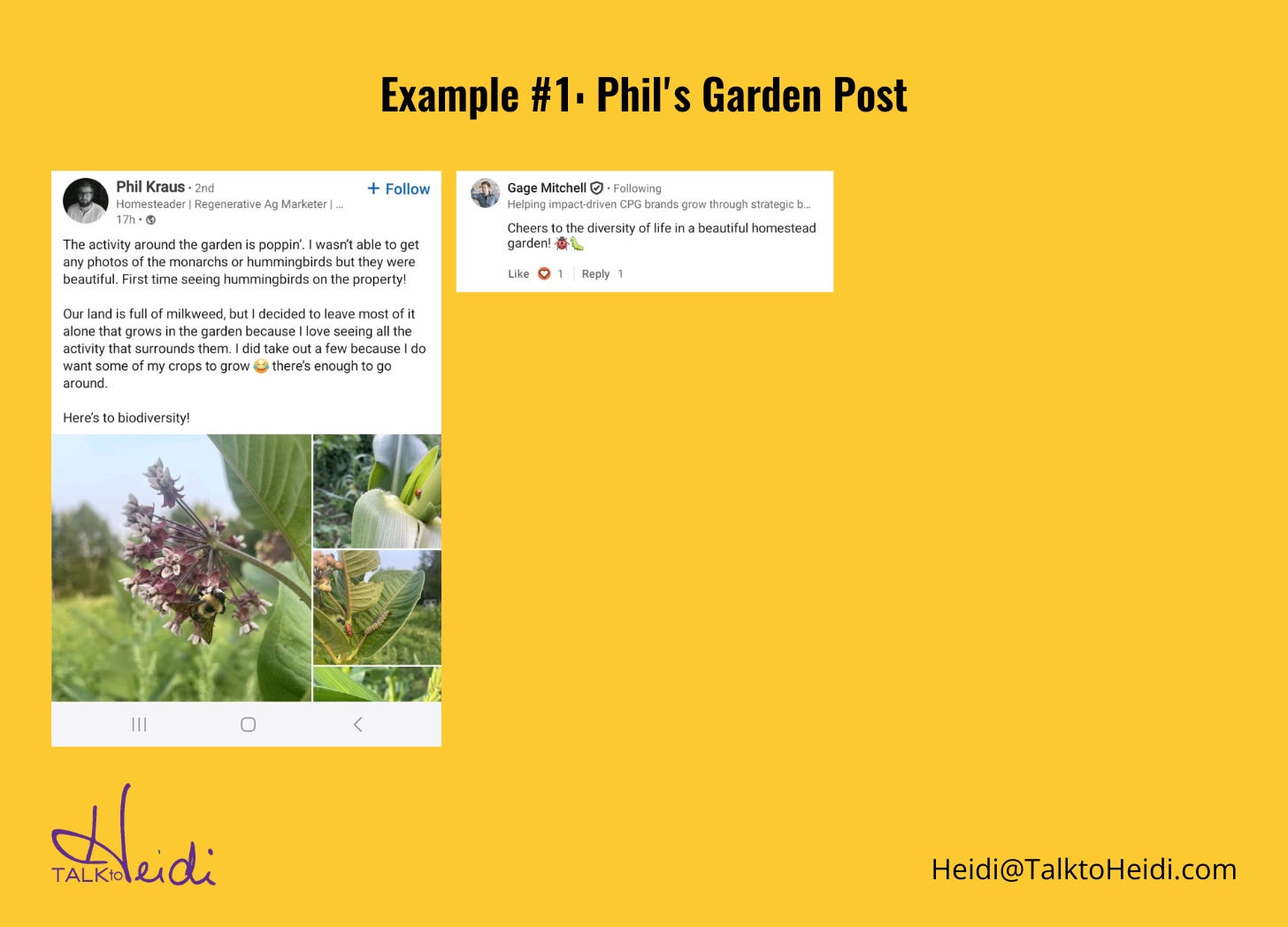
Example #1: Phil's Garden Post
Gage’s Comment: ‘Cheers to the diversity of life in a beautiful homestead garden! 🐞🐛’
VALUE Version: ‘Phil, how cool that you’re seeing hummingbirds for the first time! One of my clients noticed more bee activity after shifting to native species. Have you seen changes in crop resilience tied to promoting biodiversity? Anyone balancing eco-goals with productivity have thoughts?’
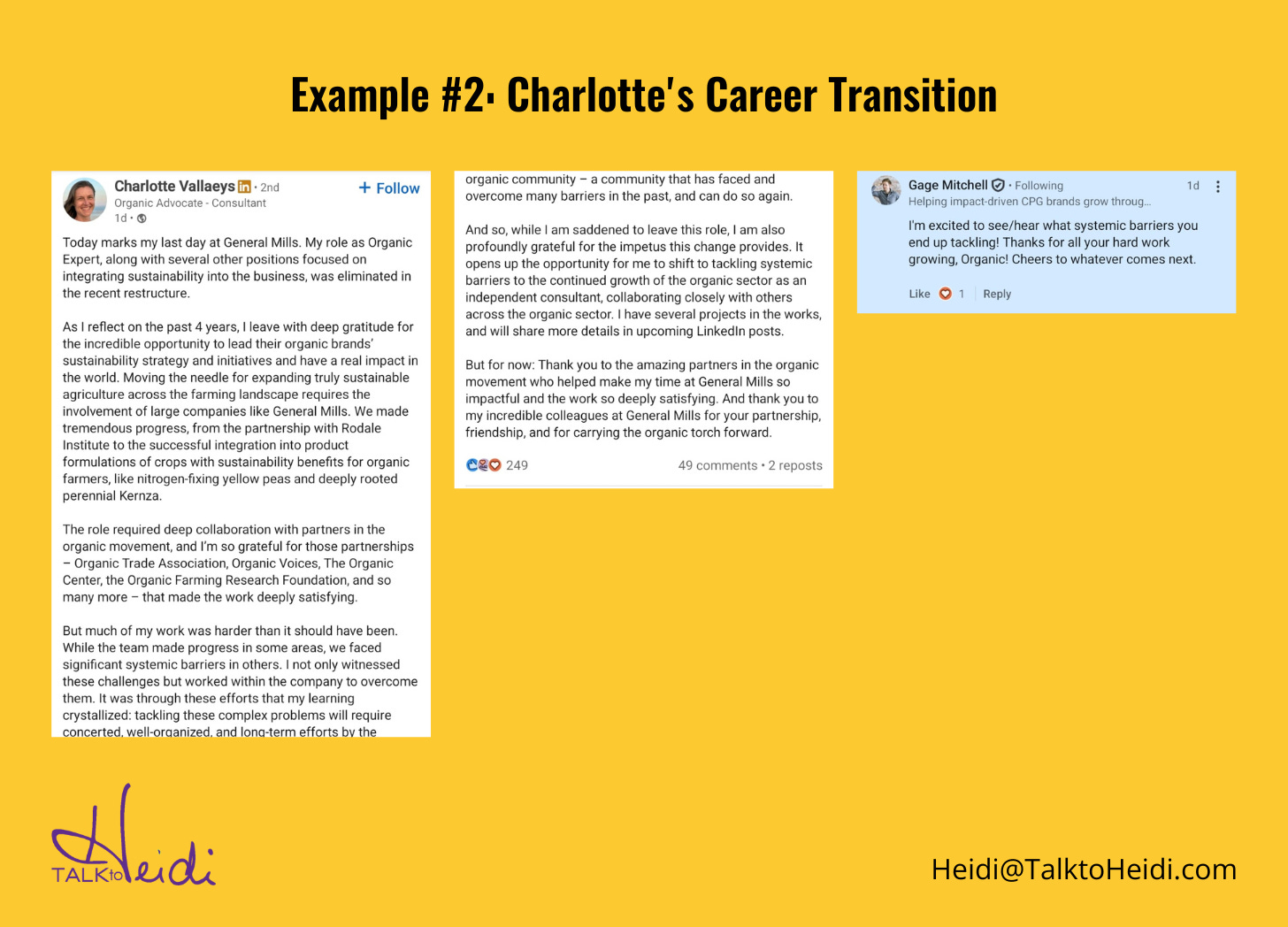
Example #2: Charlotte's Career Transition
Gage’s Comment: ‘I'm excited to see/hear what systemic barriers you end up tackling! Thanks for all your hard work growing, Organic! Cheers to whatever comes next.’
VALUE Version: ‘Charlotte, your work at General Mills set a sustainability benchmark. From my experience, aligning with vision-sharing partners drives breakthroughs. What systemic barrier in the organic market needs more collective action? Count me in for sharing resources or amplifying your next projects.’
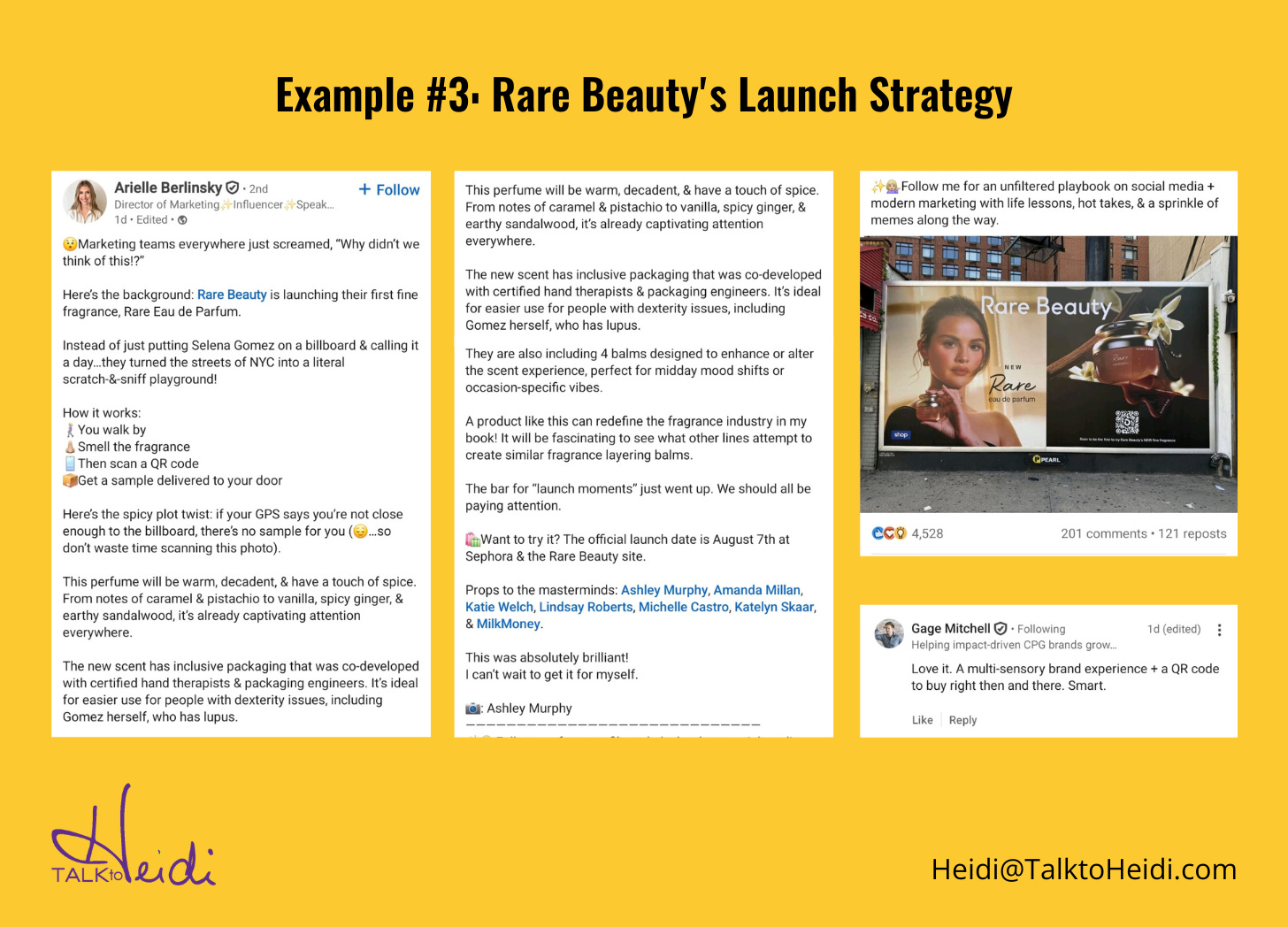
Example #3: Rare Beauty's Launch Strategy
Gage’s Comment: ‘Love it. A multi-sensory brand experience + a QR code to buy right then and there. Smart.’
VALUE Version: ‘Arielle, this scratch‑and‑sniff + GPS‑triggered sampling is genius for solving the 'try before you buy' challenge in fragrance. I’ve seen adaptive packaging open doors to new markets—are more brands in your world experimenting with digital‑physical launches?’
SEE what a difference this makes to the quality and connection in the comments?
I bet now you’re viewing Gage as a badass in his niche - plus someone with opinions, thoughts, and ideas, rather than just a cheerleader, right?
Your Turn: Make Your Comments Count Starting Now
Alright, enough theory. Time to take action.
Here's what I want you to do:
- Pick one post where you'd normally drop a drive-by 'Awesome post!' and pause.
- Ask yourself: ‘What would I say if this person told me this story over coffee?’
- Then say THAT instead using the VALUE framework.
Don't forget to tag the person you're talking to (@theirname) to ensure they get notified that you commented. More importantly, it personalizes the response so it feels like you're talking to THEM, not just broadcasting to everyone.
Because at the end of the day, people don't hire the most prolific content poster. They hire the person who consistently shows up in their feed making them think, ‘Holy shit, this person actually gets it. This person gets ME.’
Ready to stop leaving your expertise in the cheerleader section? Let's me know in the comments what happened with your comment.
Want to turn your comments into clients without the ick and hustle?
Join my Clients from Comments workshop — the proven $97 step‑by‑step system for knowing exactly who to comment on, what to say, and how to turn those conversations into sales.
For $97, you’ll walk away with:
- A repeatable commenting framework that builds trust and drives leads
- Tools to spot high‑conversion opportunities in your feed
- Real examples you can adapt to your niche immediately
Here’s what past participants say:
- “I finally understood who to comment on — it changed everything.”
- “This system feels doable and actually fun — no more dreading comments.”
- “Finding purposeful comments fast — pure gold for my time‑starved life.”
One $97 investment. One strategic comment. Unlimited potential clients.


