
TL;DR
- Most people skip straight to tactics — commenting more, posting more, connecting more — without any foundation underneath. It doesn’t work long term.
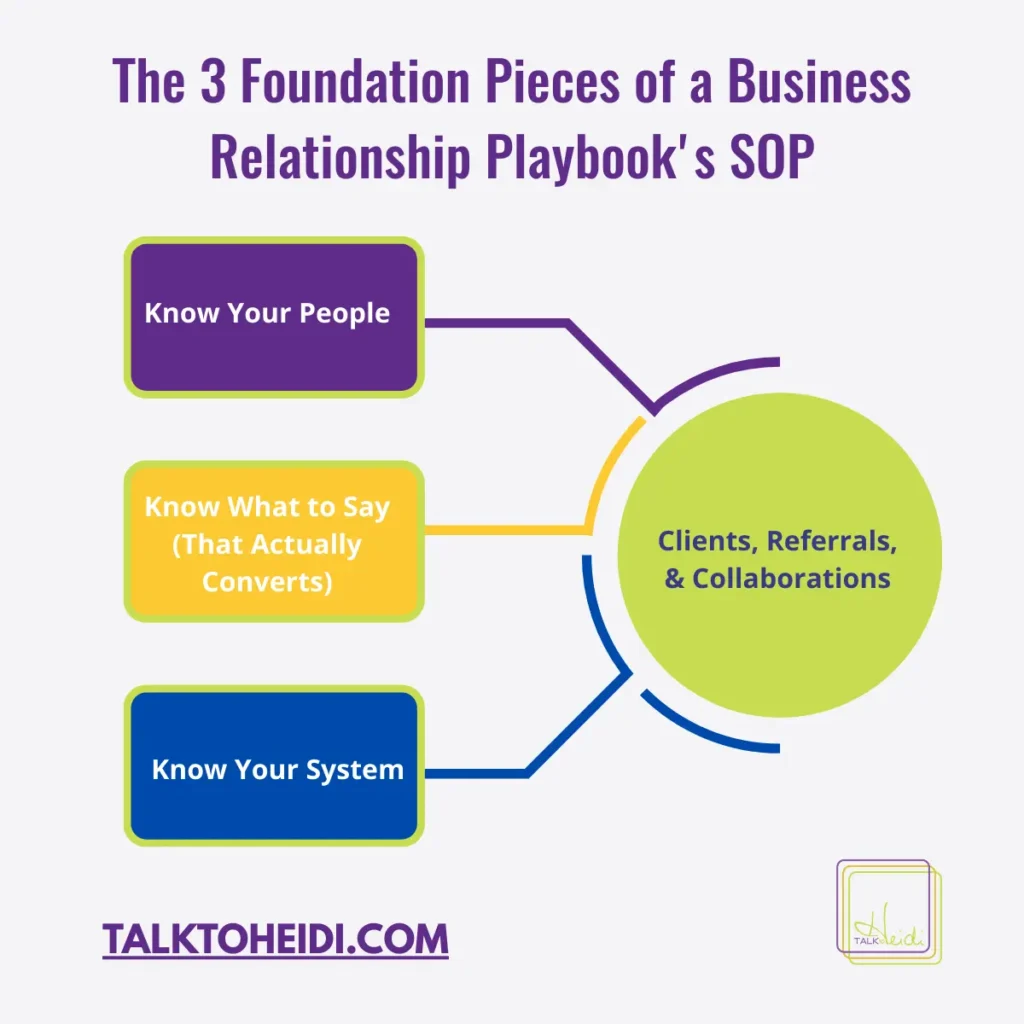
- There are three foundation pieces every business relationship playbook needs. Miss one and the whole system leaks.
- Know Your People — who’s actually worth your time and why
- Know What to Say — how to position yourself without sounding salesy
- Know Your System — how to track and follow up so nothing falls through the cracks
Here’s a conversation I have at least once a week.
Someone reaches out... established service-based entrepreneur, solid reputation, real results with clients, a small team behind them... and says some version of this:
“I know I should be building relationships more intentionally. I know I should be following up with people. I know comments and DMs work. But I don’t have time.”
And I get it. Because the internet will tell you a hundred different things to do. Comment on 10 posts a day. Send 20 connection requests a week. Post 3 times a day. Post 5 times. Build a personal brand. Start a newsletter. Get on YouTube.
All tactics. No foundation. And tactics without foundation are just noise.
It always makes me wonder why we're leaving intentionally growing and nurturing business relationships 100% to chance. No list. No plan. Without a standard operating procedure (SOP), we’re just implementing someone else’s playbook without knowing if it actually fits your people, your voice, your business. I even have one for my monthly Connect & Collab networking events... but relationships?
Yet, this is the plan that actually helps us create and drive a successful pipeline.
Before you build the system, you need the foundation. And the foundation has exactly three pieces.
Foundation Piece 1: Know Your People
Not just your ideal client. Your entire ecosystem.
Most established business owners can describe their ideal client instantly. They know the title, the company size, the problem they solve. That’s good. But it’s not enough.
Your ideal client is only one of six types of people who belong in your relationship ecosystem. The others are strategic referrers — peers, consultants, partners — industry leaders who can lend you borrowed trust, service providers you’ll want relationships with before you need them, current and past clients who are your strongest referral engine, and the superfans and community connectors who open doors you didn’t even know to knock on. These are often the people who get you in the room with your ideal client in the first place.
Your ideal client is who buys from you. Your strategic target audience is everyone who leads you to the people who buy from you.
One of my clients, a leadership coach, knew exactly who she served: women executives who needed leadership support. Smart, clear, specific. But when I asked her who else had access to those women... who already had their trust, who could introduce her... she went quiet.
“I’ve never thought about it that way.”
She’d been ignoring the HR directors, the peer coaches, the consultants already inside those organizations. The people who could have been walking her straight through the door she was knocking on from the outside.
Knowing your people means mapping the full ecosystem... not just your buyer list.
The tool for this: your Hot 40 List. The 20–40 specific people worth investing in right now. Not 7,000 connections.
Not your entire network. Just the ones where the relationship... if built intentionally... creates the most compounding opportunities.
Foundation Piece 2: Know What to Say (That Actually Converts)
This is where most people get stuck.
They know they should be commenting, DMing, following up. But when they sit down to actually do it, they either go full cheerleader (“Great post!”) or full pitch (here’s what I do, want to hop on a call?).
Neither works well, if at all. One is forgettable. The other is off-putting.
What actually works is positioning. Knowing how to show up in a conversation — comment, DM, coffee chat, networking event — in a way that demonstrates your expertise naturally, without announcing it. Without performing. Without sounding like you’re running a script.
For years, when my clients weren’t sure what to say or how to say it, I’d ask them: "if you were sitting in a coffee shop having coffee with someone, would you say this to them?"
If the answer is yes, go for it. If the answer is no, then it’s a no.
That evolved into being called The Starbucks Test.
The 'rule' that's allowed me to excel with building relationships online is...
"If you wouldn’t say it in person, don’t say it online."
Online conversations work exactly the same as in-person ones... you ask questions, share a perspective, find common ground, follow up. The only difference is the screen and the keyboard. The words can be identical. The awkwardness comes from forgetting that.
When you know what to say and how to say it... when you have a framework for showing up in conversations in a way that’s genuinely useful without sounding like you’re running a script... you stop dreading the blank comment box. You stop sending DMs that go nowhere. You start having conversations that actually go somewhere.
Foundation Piece 3: Know Your System
This is the piece almost everyone skips. And yet, this is the one that makes everything else compound.
You can know exactly who your people are. You can know exactly what to say. But if you don’t have a system for tracking those relationships and following up consistently, good relationships and future clients fall through the cracks.
You have a great conversation. Real connection. Genuine interest on both sides. And then six months later you think: “oh, I wonder what happened with them. We were going to collaborate on something.” But so much time has passed that now you don’t reach out because it’s awkward.
That’s not a motivation problem. It’s a memory problem. Our brains can’t remember everything in the day-to-day of so many tasks between business and personal. Which is why having a tracking system is so important.
Know Your System means having a simple way to track who matters, when you last connected, what you talked about, and what the next natural touchpoint is. It doesn’t have to be complicated. A spreadsheet works. A CRM works. A notebook and pen work. Whatever keeps the relationships from going cold because life got busy.
Because the truth is you cannot manage meaningful relationships in your head. And the ones that fall through the cracks? Those are often the ones that would have compounded the most.
Why All Three — And Why This Order
Here’s what I see happen constantly.
Most of the people I talk to have already tried to fix this. They hired a content coach. Rewrote the profile. Committed to a posting schedule. The belief they were carrying: if I could just get the content right, everything would change. So they fixed the content. And nothing changed. Because content was never the actual problem.
Here’s what I mean. Someone hires a content coach and builds out Know What to Say before they know who they’re talking to. They’re writing great comments... for the wrong people. The content lands. Nothing converts.
Or someone builds a beautiful Hot 40 list, starts investing in those relationships, and then drops the ball because they have no system. The relationships go warm, then cold. They start over.
The order matters.
Know Your People first. You need clarity on who’s worth your energy before you spend any of it.
Know What to Say second. Once you know who you’re talking to, you can figure out how to position yourself naturally in conversations with them.
Know Your System third. Once you’re having the right conversations with the right people, you need infrastructure to make sure no one falls through the cracks.
Each piece makes the next one more effective. Skip one and the whole system leaks.
What This Looks Like When It’s Working
When all three foundation pieces are in place, the experience of business development completely changes.
You stop starting every week from scratch, wondering who to reach out to. You have a list. You know who’s in your ecosystem and why they matter.
You stop staring at a blank comment box, not knowing what to say that doesn't come off fake or salesy. You have a framework. You sound like yourself.
You stop losing track of promising conversations. You have a system. The relationships stay warm. The follow-up happens. The opportunities don’t die quietly in your DMs.
And over time... this is the part that makes the difference... the relationships compound. One referral leads to three. One collaboration opens a door you didn’t know existed. One introduction changes the trajectory of your year.
That’s what foundation does. It makes the compounding possible.
What Comes Next
In the next three posts, we’re going deep on each foundation piece... what it actually looks like to build it, where people get stuck, and how to do it in a way that feels like you instead of a strategy you read somewhere.
But before we go there: which of the three do you feel shakiest on right now?
Do you know exactly who your 20–40 people are... by name? Can you articulate how you position yourself in a comment or a DM without it feeling forced? Do you have a system that ensures you’re following up consistently?
Drop it in the comments. I read every one.
Not sure which of your connections are actually worth your time? That's exactly what Find Your 40 solves. In two 90-minute sessions over 14 days, we map your full relationship ecosystem... all six types of people who belong in your network... and build your Hot 40: the specific people worth investing in right now, with context on why each one matters and what to do next. You leave with a list you'll actually use. Not a vague directive to "network more." A specific, ordered set of first moves. $1,997 • 2 sessions • 14 days • 5 clients per month $1,497 of this investment credits toward The Relationship Intensive if you continue within 6 months. Apply via the contact form or send a direct message on LinkedIn.
Next: Know Your People — Building Your Relationship Ecosystem (Not Just Your Client List)
Previously: What Is a Business Relationship Playbook?
Frequently Asked Questions
Why do tactics stop working without a foundation underneath them?
Tactics borrow from a system that doesn’t exist yet. Commenting more only works if you’re commenting on the right people’s content... which requires knowing who your people are. DMing only works if you have something real to say... which requires knowing how to position yourself. And follow-up only works if you have a system to catch the people worth following up with. Without the three foundations, every tactic leaks.
What’s the difference between my ideal client and my strategic target audience?
Your ideal client is the person who pays you. Your strategic target audience is everyone who leads you to the person who pays you... referral partners, industry peers, past clients, introducers, and the people who already have the trust of the rooms you want to be in. Most service professionals only build relationships with buyers. The ones with the most predictable pipelines invest in both.
How long does it take to build the three foundation pieces?
Know Your People can be clarified in a focused 14-day sprint (that’s what Find Your 40 is built for). Know What to Say is a skill built over four to six weeks of deliberate practice... it gets faster as it gets natural. Know Your System takes a few hours to set up and a weekly rhythm to maintain. The foundations aren’t a one-time build... they’re a living system you refine as your business evolves.


