
‘Comment impressions sounds like a great tool for expanding our influence on the platform.’
‘Your comments are no longer background noise. They're front-row seats to visibility.’
‘My post only got a little over 3K views, but my comment got over 8K and counting.’
LinkedIn just rolled out comment impression tracking and everyone's suddenly a commenting expert, celebrating the new vanity metrics like it's the return of Jesus.
8-year-old Heidi, pigtails swinging, danced around chanting 'I told you so!' Adult Heidi just eye-rolled and said 'thanks LinkedIn for validating conversation-first strategies.’
Now maybe it'll be easier for my clients to realize I'm 110% serious when I say:
'If you're running short on time, skip posting and spend 30 minutes commenting instead.'
I've been teaching this in the online space for 15+ years (using it for more than 35).
Here's the proof it actually works...
What My Week of Comment Tracking Actually Revealed
I tracked my comments for a week using LinkedIn's new impression feature, and here are 3 examples with the results.
And because context is key, here are details:
- All comments were left on posts by either an ideal client or a peer who has my ideal clients in their audience.
- None of the comments were throwaways - they were all crafted using my VALUE framework, which I shared in a previous article.
- Each one was strategic and intentional, not random.
- These numbers were tracked within 7 days of posting each comment.
- Did I also have some fun? Absolutely.
Example 1: Connection Over Conversion
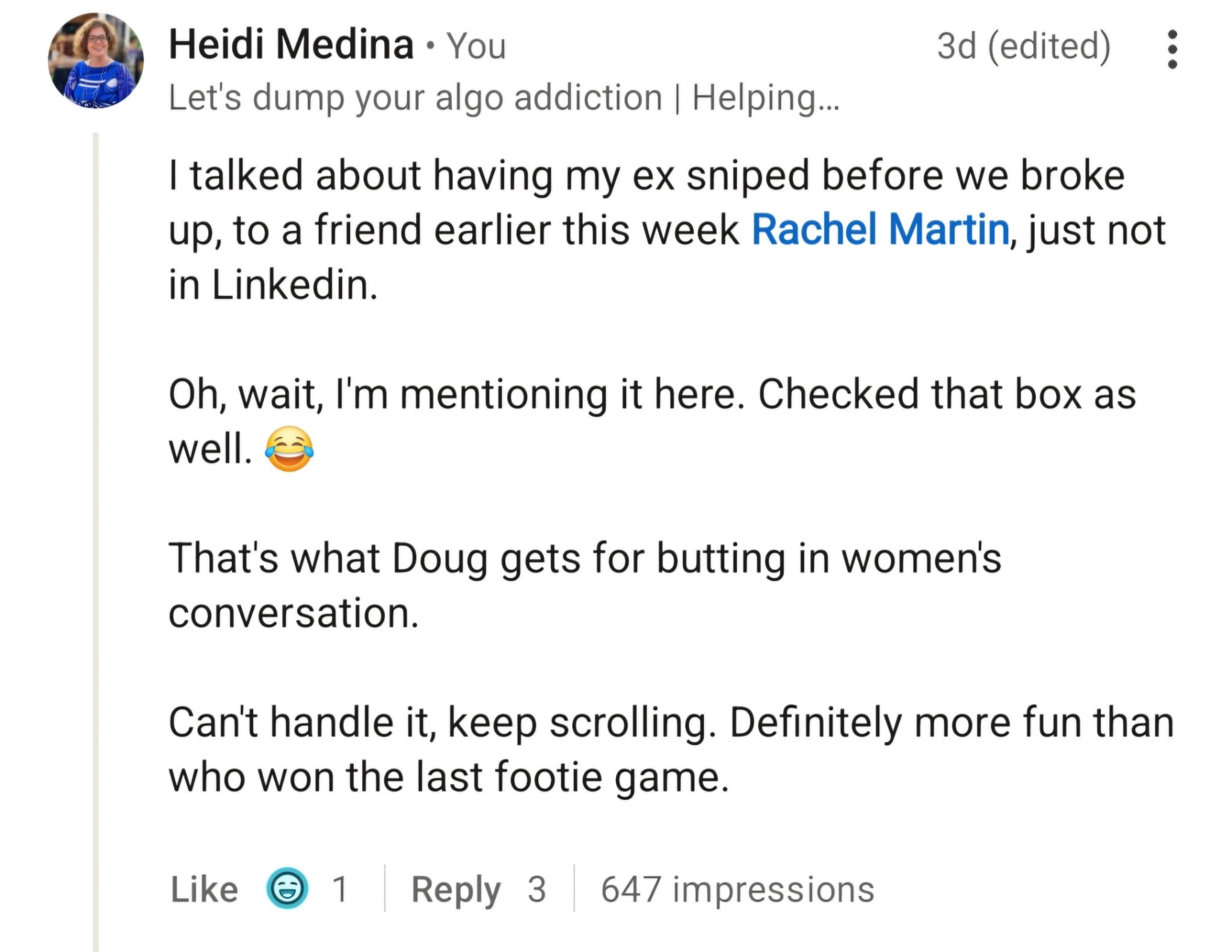
Lighthearted banter with a peer about a 'troll'
- 647+ impressions → 2 connection requests, 11 followers dropped
- The lesson: Sometimes it's about both attraction AND elimination
Fun? Absolutely.
Conversion-generating? Nah.
But hey, some conversations are purely for connecting and letting people get to know you.
Example 2: Strategic Help Wins
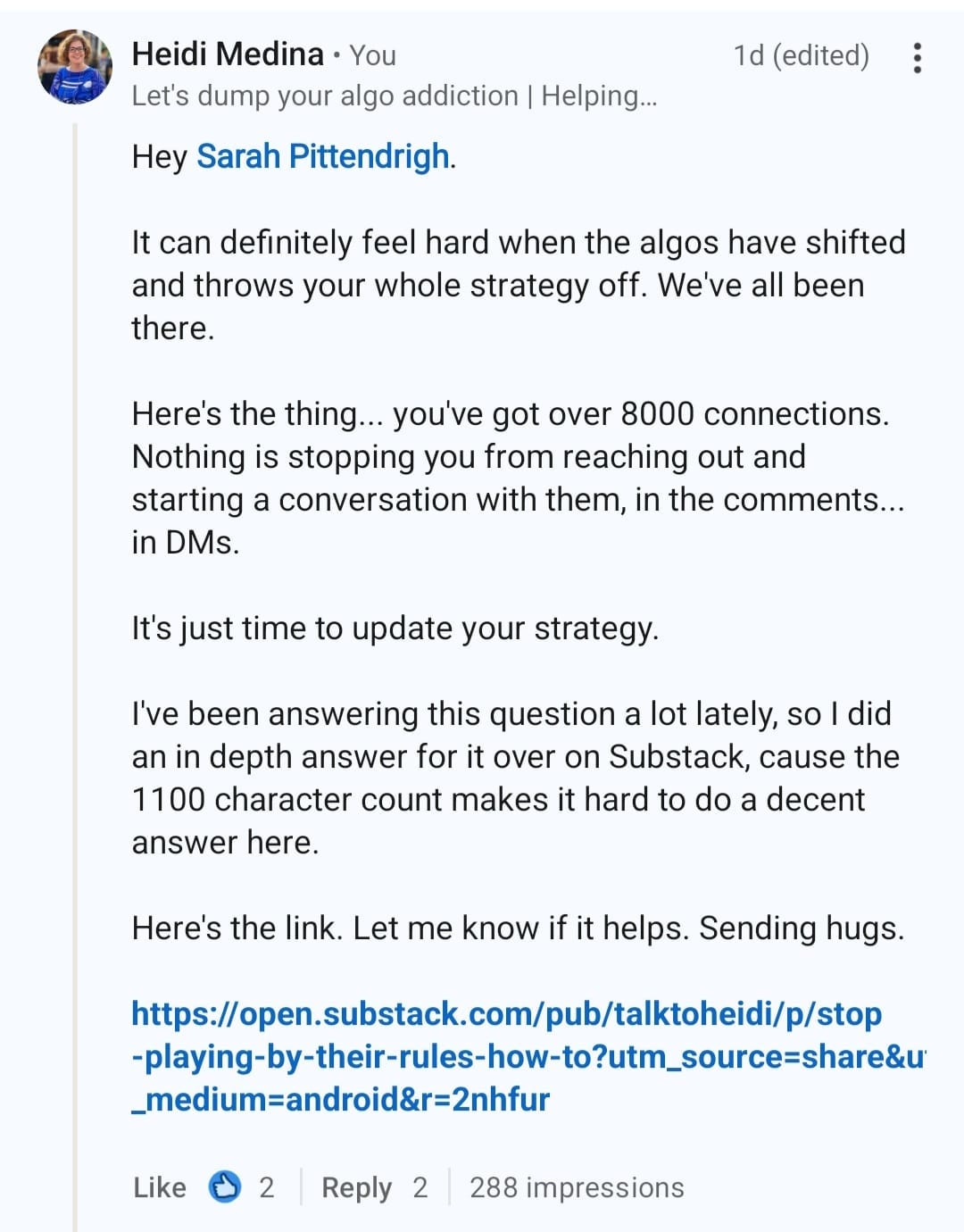
Helping an ideal client struggling with algorithm changes
- 288+ impressions → 6 Substack subscribers, 4 LinkedIn connections, 2 DM conversations
- The lesson: Lower reach, higher ROI when you help the right people
This comment had me asking peeps to check out another platform which is a big ask - so those 6 new Substack subscribers are a big win.
Example 3: Authority Building
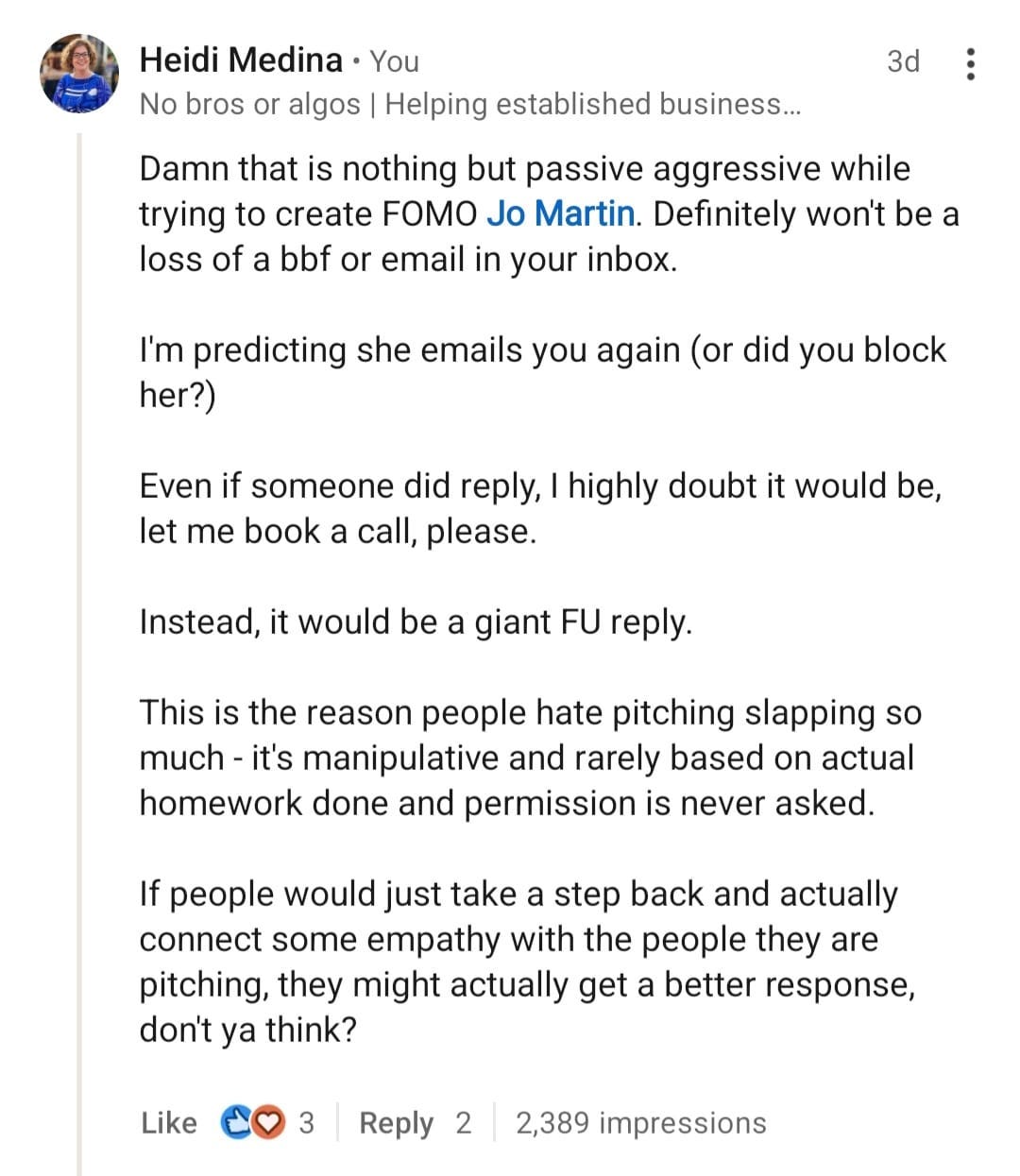
Calling out pitch slapping with a peer
- 2,389+ impressions → 3 peer connections, 1 collaboration scheduled
- The lesson: High reach + values alignment = perfect positioning and authority
Sharing values is a great way to build authority and attract the right peeps - for me peeps who hate pushy tactics and wanna do selling differently.
Conclusion:
Connection = High engagement, lower trackable conversion
Strategic help = Lower engagement, high-quality conversion
Expert positioning = High reach + authority building + good conversion
It's not about the impression count—it's about intentional networking.
And there's so much VALUE in this approach in commenting…
Getting a REAL conversation started. So, I’m going to share with you how we can take these impression numbers and use them to our advantage to build real relationships faster and easier than we were before. Because one HUGE positive just came out of all this…
Your ideal clients are going to be paying MORE attention to the comments under their content, rather than ignoring them.
Let me show you how I’m using impression data to selectively connect with more ideal clients.
4 Ways to Use Impression Data Like a Strategist (Not an Addict)
While I know the comment impression rollout is new for a lot of peeps, I've had it since January (I believe Portugal was part of the beta test).
These tips work for commenting on any platform—you just don't have fancy numbers on the others. But if we're on LinkedIn, we might as well use the advantages they're giving us strategically. Here's how I've been using impressions to improve my marketing strategy:
- Where are my ideal clients most active?
Before you comment on a popular post, scroll through the interactions (the like button) and see who hit the button. You can also check the comments, but more people are more likely to push the thumbs up than drop a comment, so the interactions are an awesome indicator of where your people are hanging out. - Are these impressions from MY people or random scrollers?
Pay attention to which posts are giving you the most impressions - are you noticing more of your ideal clients and target audience engaging with the content - or people who aren’t the right fit. Track impression patterns to pinpoint where our ideal clients spend time. - What commenting style actually triggers action?
Try out different commenting styles to see what actually triggers your people to act - responding to your comment, sending a connection request, reaching out in DM, or engaging on your other content. - How can I be most intentional on popular posts?
Stop dropping throwaway comments on popular posts - instead since those are the ones giving you the most reach, be most intentional here to start smart conversations that highlight who you are and what you’re about.
The goal?
Use their tools against their game. Skip the vanity metric trap and focus on commenting on posts where your ideal clients are already engaging to help get you seen.
It's algo-proof and doesn't leave us dependent on someone else's playground to deliver clients. Cause I don't know about you, but I'm done burning out to fill someone else's bank account while my business stays stuck.
Let's Choose Our Hard Together
Look, the algorithm will change again next month. Right now, LinkedIn is boosting comment reach to hook you into commenting more (then they’ll start dropping that reach once they got you hooked). So what's it gonna be…more manipulation by the platforms, or a strategy that actually converts?
Let’s choose purposeful commenting over impression addiction, and watch how much easier business becomes. Less hustle, more human. Less metrics, more money. After all, we’re here to grow our business. Not just chit chat.
Ready to create comments that convert into sales?
Grab the Clients from Comments Workshop for $97 and learn the exact system both me and my clients are using to purposely start conversations that convert into paying clients. While everyone else is still trying to crack LinkedIn's latest code, we'll be booking calls.
Because the real secret isn't getting more impressions—it's making the RIGHT impressions with the RIGHT people at the RIGHT time.


