TL;DR
- Most people treat networking events as the strategy. They’re not. They’re the starting line.
- The room gets you in front of people. The follow-up is where the deal actually happens... sometimes days later, sometimes 11 months later. Without a system to track and follow up intentionally, the right conversations disappear into the void and you’ll never know what they could have become.
- Two real examples in this post: a $600,000 contract that came from a birthday party, and $14,000+ in revenue from a 20-minute virtual networking event. Neither happened in the room. Both happened because of what came after it.

One of my biggest networking wins came from attending a client's birthday party back in North Carolina where I met the decision-maker for GE and signed a $600,000 landscape contract a few weeks later.
Were we there to do business? Absolutely not. We were there to celebrate a birthday. We didn’t talk business that night.
But a few weeks later, I followed up. Built the relationship. And signed a $600,000 landscape contract.
That birthday party — 17 years ago — was my lightbulb moment. Business networking can happen anywhere. The magic, though? It rarely happens in the room at that moment.
It happens in the follow-up.
The Mistake Almost Everyone Makes After a Networking Event
I attend A LOT of networking events. On average one to two (or more) a week. And what I see truly amazes me.
Incredibly talented service professionals attending, connecting, having good conversations, actually talking plans for catching up later. Then they head out after collecting the name and contact details, feeling good they had a successful networking event.
And yet, they didn't.
Because they didn't follow up.
Maybe life happened, but most often it's that they didn't take a moment to make notes. Then they got busy, and didn't even bother is accept the connection request. And all those connections and conversations go cold.
Six months later, they end up in a breakout room with the person and don't even remember they've met before.
How do I know all this?
Because I experience it after ever networking event I attend. I was just in a room last week with someone who didn't have a clue who I was and yet, the last time we met, she had invited me to guest on her podcast. She never accepted my LinkedIn request. And she invited me on her show again. I politely turned the offer down.
People wonder why networking doesn't work for them.
Networking didn’t fail them. The follow-up system did. Or rather... the lack of one. Also a lack of patience. Both trust and relationships take time to build, but a lot of people think they should happen in one or two conversations.
Only 3% of people are ready to buy when you first meet them. Three percent. The other 97% need time, multiple touchpoints, and trust to actually develop before they’re ready to say yes. If you’re not following up intentionally... and tracking who you’ve spoken to, when, and what you talked about... you’re leaving most of your results on the table.
Not because the conversations weren’t valuable. Because you had no system to make them compound.
What 20 Minutes at One Event Actually Produces
A couple of years ago, I gave a 20 minutes talk to a group of women at a virtual networking event. All of them were my ideal clients.
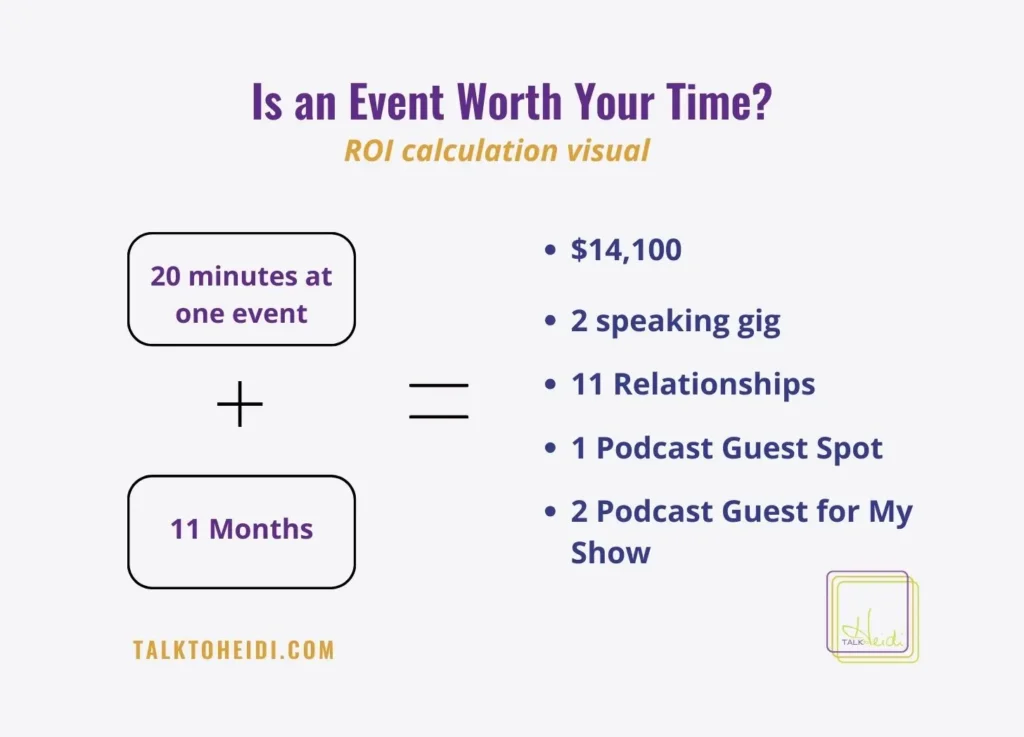
Here’s what that 20 minutes turned into over the next 11 months:
- Over $14,100 in revenue from 4 clients
- 2 more speaking gigs
- A guest spot on a podcast
- Lasting relationships with 11 amazing women
The first client signed up two months after the event. The last one came 11 months later.
I know these numbers because I tracked them. And none of it would have happened without a deliberate follow-up strategy. Because not one single one of these 11 women reached out to me after the event.
20 minutes. 11 months. $14,000+. Two speaking gigs. Eleven relationships.
That’s not luck. That’s what an intentional system does.
The ROI Calculation Nobody Does (But Everyone Should)
Have you ever actually calculated the return on investment of the networking events you attend?
Your time has a value. If you charge $500 for an hour of your time, every event you attend costs you that... plus registration fees, travel, prep time, and the energy it takes to show up well. To break even, you need to get at least that much value back.
Value doesn’t always look like a signed contract. It looks like:
- A client or referral that converts... eventually
- A friendship or mentorship that opens unexpected doors
- A speaking opportunity that puts you in front of a new audience
- A peer relationship that becomes a referral partnership
The problem is that most of this value is invisible if you’re not tracking it. The client who signed 11 months after an event? Without tracking, I'd have no idea that 20-minute talk was the origin point. I'd just know a client found me somehow.
But when you track, you start to see the patterns. You find out which events consistently produce results and which ones consistently drain your time. You can make smarter decisions about where to show up... and where to stop showing up.
The guesswork comes out. The ROI goes up.
What an Actual Follow-Up System Looks Like
A follow-up system doesn’t have to be complicated. At its core, it answers four questions for every person worth investing in:
- Who are they and why do they matter? What’s the connection... potential client, referral partner, collaborator, peer?
- When did we last connect? Not a like or a reaction... an actual conversation.
- What did we talk about? Even a few words. “Mentioned she’s looking for a new consultant.” “He’s speaking at X conference in March.”
- What’s the next natural touchpoint? A check-in on something they mentioned. A relevant article. A congratulations on something that happened. Something genuine, not forced, but reminds them of how you know each other.
That’s it. Four fields. A spreadsheet handles this. A simple CRM handles it. Whatever you’ll actually open and update, that’s the right tool.
The discipline is a weekly review. Fifteen to twenty minutes, once a week. Who have you not been in touch with that you should have? Who mentioned something last month that deserves a follow-up now? Who came to mind this week and you didn’t reach out?
That weekly review is what turns good conversations into compounding relationships. Without it, you’re starting from zero every time.
Following Up Isn’t Chasing. Someone Has to Go First.
I mentioned following up to a group of people a few weeks back, and the immediate response was 'why would I chase them?
Immediately I asked, 'well someone has to go first, why not you?'
Look I get it that you don't want to seem desperate or salesy. But following up is not chasing. Someone really does have to go first. If you see benefit in the relationship with the person, why not you?
Most stalled relationships aren’t dead... they’re in what I call a Mexican standoff. Both people waiting for the other to make the first move (or the other person just forgot because they got busy or didn't take notes). Before you know it, too much time has passed and now it's feeling too weird to reach out.
Someone has to go first. If you saw the value in that conversation, if you genuinely believed it could go somewhere... why not you?
A simple message. A check-in on something they mentioned. A piece of content that made you think of them. That’s not desperate. That’s not annoying. That’s what people who build real relationships actually do.
The $600,000 contract didn’t happen because the GE decision-maker called me. It happened because I followed up. I went first. And the relationship built from there.
The Room Gets You In Front of People. The System Turns People Into Results.
Networking events are not the strategy. They’re an input. A source of raw material... people worth knowing, conversations worth continuing, relationships worth building.
The strategy is what you do with that raw material. The follow-up. The tracking. The intentional investment in the right people over time. Because relationships take time to grow.
This is the core of my CIRCLES Method... the relationship infrastructure that turns scattered networking into a compounding system. You Connect in the room. You Invest in the follow-up. You Refer, Collaborate, Lead, Expand, and Sustain from there. None of it happens without the system behind it.
The birthday party got me in the room with the right person. The follow-up got me the contract.
The virtual event gave me 20 minutes with the right women. The follow-up system turned those 20 minutes into 11 months of compounding results.
Same principle. Every time. And nothing an algorithm dictates. You're fully in control.
Your Next Move
Think about the last networking event you attended. The last conference, webinar, virtual mixer, or — yes — even the birthday party where you ended up in a great conversation with someone.
How many of those conversations did you follow up on? How many are sitting dormant right now because life got in the way and you had no system to catch them?
Start there. Not with a new event. Not with a bigger network. With the conversations you already had that haven’t gone anywhere yet.
Because the room got you in front of them. The follow-up is still waiting.
So tell me in the comments, what’s your biggest networking win... and how long after the initial conversation did it actually convert?
Ready to stop letting great conversations go cold?
Find Your 40 is the starting point. In two 90-minute sessions over 14 days, we identify the 20-40 people already in your network worth your intentional energy, and map the first moves to reactivate, deepen, and compound those relationships. You leave with a list you'll actually use and a Next Steps Map with specific, ordered first moves. Not 'network more.' Exactly who, exactly what, exactly when.
$1,997 • 2 sessions • 14 days • 5 clients per month $1,497 of this investment credits toward The Relationship Intensive within 6 months.
Frequently Asked Questions
How do you follow up after a networking event without seeming pushy?
The key is specificity and genuine curiosity — not a generic ‘great to meet you’ message. Reference something specific from your conversation: a challenge they mentioned, a project they’re working on, something they said that stuck with you. ‘I was thinking about what you said about X — here’s something that might be relevant’ is not pushy. It’s attentive. The follow-up that feels pushy is the one that’s clearly angling for something. The follow-up that feels welcome is the one that’s clearly about them.
How long after a networking event should you follow up?
Within 48 hours for a warm, brief message that references the conversation while it’s fresh. Within two weeks for a more substantive follow-up if there was genuine interest on both sides. After that, the relationship doesn’t expire — but the follow-up needs to acknowledge the gap. A message that says ‘I’ve been thinking about what you mentioned at X event’ is still worth sending six months later. Most stalled relationships aren’t dead. They’re waiting for someone to go first.
What should you track after a networking event?
Four things for every person worth following up with: who they are and why they matter to your network, when you last had a real conversation (not a like or reaction), what you talked about (even brief notes), and what the next natural touchpoint is. This doesn’t require a sophisticated CRM. A simple spreadsheet with those four columns, reviewed weekly, is enough to ensure nothing valuable falls through the cracks. The goal is to be able to pick up any relationship exactly where you left it, no matter how much time has passed.
How do you calculate the ROI of a networking event?
Start by assigning a value to your time — your hourly rate, or what you could have earned in that time. Then track every result that traces back to that event over the following 12 months: clients, referrals, speaking opportunities, collaborations, relationships that became referral partners. Most people underestimate networking ROI because they don’t track long enough. The client who signs nine months after an event still counts. Without tracking, that connection looks random. With it, you can see exactly which events and which rooms consistently produce results — and which ones are just consuming your time.
What’s the difference between networking and relationship infrastructure?
Networking is an event or a tactic — something you go and do. Relationship infrastructure is the system underneath it that makes networking compound. You can attend every event in your city and still have an unpredictable pipeline if there’s no system for what happens after. Relationship infrastructure is the follow-up rhythm, the tracking, the intentional investment in the right people over time. Networking gets you in rooms. Infrastructure is what turns those rooms into results. The birthday party was networking. The $600,000 contract was infrastructure.


