
TL;DR
- The mistake: Most people only build relationships with potential buyers — and miss the 5 other types who actually fill their pipeline.
- The insight: Your ideal client and your strategic target audience are different. You need both.
- The fix: Build relationships with 6 specific types of people who create compounding opportunities.
- The action: Start your Hot 40 list today using the framework in this post.

“Who are you trying to connect with on LinkedIn?”
I asked this question to a leadership coach who’d been struggling to fill her pipeline despite posting consistently and networking regularly.
“Women executives who need leadership support,” she said without hesitation.
Smart answer. Clear ideal client. She knew exactly who she served.
But then I asked: “Who else has access to those women? Who already has their trust? Who could introduce you?”
Pause.
“I’m not sure... I hadn’t thought about that.”
And there it is.
One of the most expensive mistakes I see established service providers make. Not expensive in an obvious way. Expensive in the way where you’re working harder than you need to, posting more than you should have to, and still wondering why the pipeline feels so unpredictable.
Because they’re only building relationships with one type of person.
The buyer.
Meanwhile, they’re completely ignoring everyone else who should be in their ecosystem. The ones who will actually introduce them to their clients.
The People Who Grow Fastest Don’t Just Know Who Buys — They Know Who Leads Them to Buyers
A few years ago I was the same. Only focused on my ideal client. But I kept studying the consultants and agency owners with the most predictable pipelines. Not the influencers. Not the mass marketers. The ones with real revenue and real relationships... whose names got passed around when someone asked “do you know anyone who does X?”
What I noticed is they rarely had the biggest audiences. But they were surrounded by people who vouched for them, introduced them, and opened doors without being asked.
Jay Acunzo is one of those people. Visible, yes. But the way I found him wasn’t through his content. It was through someone saying, “you need to check out what he’s doing.”
He’d built an ecosystem of the right people. The introducers. The referrers. The connectors. The door-openers.
Because most of your best clients won’t come from you convincing them directly. They’ll come from someone they already trust saying: “you need to talk to this person.”
That’s borrowed trust. And borrowed trust only works if you’ve built relationships with the people willing to lend it.
The 6 Types of People in a Successful Relationship Ecosystem
When you build your relationship ecosystem, you’re not just identifying your ideal client. You’re mapping everyone who can help you grow... not just the ones who pay you.
1. Ideal Clients (People Who Pay You)
This is where most people stop.
Your ideal client is the person who has the problem you solve, values your solution, and can afford to pay you. You need to know them intimately... not surface level. But if they’re the only relationship you’re building? You’re working way harder than you need to.
2. Strategic Referrers (Peers and Partners in Complementary Niches)
These are the people who serve the same audience as you... but in different ways. Not competitors. Collaborators. They’re already in conversation with your ideal client about adjacent problems, which means they have the trust you’re trying to earn.
For the leadership coach: executive coaches working with men, career transition coaches, organizational consultants. All already inside the world of her ideal client.
Strategic referrers are gold. They just need to know you exist, trust your work, and remember your name when the opportunity comes up.
3. Industry Leaders and Influencers (Borrowed Trust Sources)
These are the people your ideal client already follows, reads, and respects. When they mention you, even once, you inherit their credibility instantly.
You don’t need to know these people well. You need to be on their radar, add genuine value to their world, and show up consistently enough that when your name comes up, they can vouch for you.
4. Service Providers (Before You Need Them)
Designers. Copywriters. Web developers. Podcast producers. Most people overlook this category entirely.
Service providers matter because they are connectors. The brand designer working with entrepreneurs is talking to dozens of business owners every month. The podcast producer is in conversation with thought leaders every week. And they remember the people who treat them like peers... not just vendors.
Build these relationships before you need to hire anyone. They’ll refer you. And when you do need them, you’re working with people you already trust.
5. Current and Past Clients (Your Strongest Referral Engine)
Your best source of new clients is sitting right in front of you.
Most people treat past clients like closed deals and move on to chasing new ones. Which is exactly like a company only giving discounts to new customers while ignoring the ones who already paid them. Your past clients have seen the transformation. They have trust built with you. They’re the most likely to refer, collaborate, or come back.
Intentional check-ins. Genuine curiosity about how things are going. Not to upsell — to maintain. That’s where the referral engine lives.
6. Superfans and Community Connectors
These aren’t clients. They might not even be in your industry. But they get what you do, believe in it, and talk about you unprompted.
The person who comments on everything you write. The one who tags you into conversations. The community builder who invites you to speak. You can’t manufacture superfans. But you can recognize them when they show up and make sure they’re on your radar.
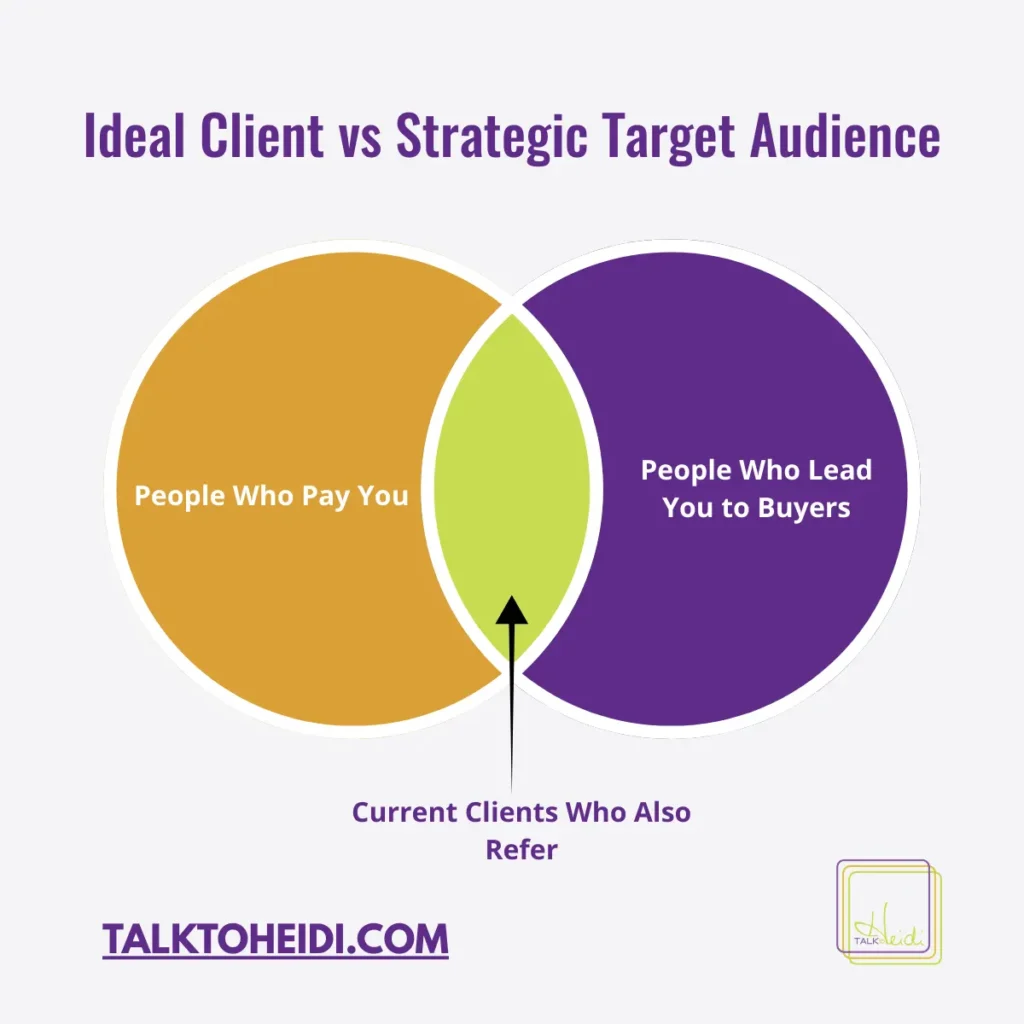
Ideal Client vs. Strategic Target Audience: The Distinction That Changes Everything
I always separate these two because how we get to know them — and how we approach building relationships with them — is completely different.
- Your ideal client is who BUYS from you.
- Your strategic target audience is who you BUILD RELATIONSHIPS WITH for referrals, introductions, support, and collaborations.
Sometimes they overlap. A current client who also refers you is both. But most of the time? They’re different people.
And if you’re only focused on buyers, you’re missing the entire ecosystem that leads people to buy from you... and increases your visibility and authority without you having to do all the work yourself.
Back to the leadership coach.
She was targeting women executives directly. Smart — they’re her buyers. But women executives are busy. Skeptical. Pitched constantly. Breaking through that noise from the outside is hard even when your offer is perfect.
When we mapped her full ecosystem, here’s who we found she’d been ignoring:
- HR directors who coordinate leadership development programs and recommend coaches to their executives
- Admin assistants who manage executive calendars, filter requests, and know who the executive trusts
- Peer coaches working with men who could easily refer the women coming through their practice
- Consultants already doing culture and change management work inside those organizations
- Authors and podcast hosts in the women’s leadership space who could mention her work or invite her to contribute
When she shifted to building relationships with these people — not instead of the executives, but alongside them — everything changed. Because these people already had the trust she was trying to earn. They were easier to connect with. And one introduction from them carried more weight than ten posts she could write.
One Thing Most People Never Think About: The Gatekeeper
The person with the most access isn’t always the person with the title.
Admin assistants, office managers, executive coordinators — they manage the calendars. They filter the requests. They know who the executive trusts and who they’re avoiding.
And when an admin assistant recommends someone? Executives listen. Because that person has already done the filtering.
I’ve watched this play out: a consultant builds a genuine relationship with an admin — not to “get to” the executive, just treating them like the professional they are. The admin mentions them when the executive asks if they know anyone who does X. Introduction happens. Trust is pre-established. Deal closes.
Not because the consultant pitched harder. Because they built the right relationship with the right person.
Building Your Relationship Ecosystem: A Practical Exercise
Enough theory. Let’s make it real.
Grab a piece of paper or open a doc. We’re mapping your ecosystem.
You don’t need hundreds of relationships. In most cases, we’re talking fewer than 100. The right ones. Intentionally invested in.
Step 1: Your Ideal Client
Who do you serve? Be specific. Not “small business owners.” Not “entrepreneurs.” Specific titles, company sizes, problems. Write it down.
Step 2: Your Strategic Referrers
Who else serves this same person — differently? Who’s already in conversation with your ideal client about adjacent problems? Write down 5–10 types.
Step 3: Industry Leaders They Already Follow
Whose newsletter does your ideal client read? Whose podcast? Whose content do they share? Write down 5–10 people.
Step 4: Service Providers You’ll Need
Who would you hire if budget weren’t a constraint right now? Write down 3–5 types.
Step 5: Current and Past Clients
Who’s already worked with you and seen the results? Write down at least 10 names.
Step 6: Your Superfans
Who shares your work unprompted? Who tags you into conversations? Who’s genuinely excited about what you’re building? Write down 3–5 names.
Building Your Hot 40 List
Now turn that ecosystem map into an actionable list.
Your Hot 40 is the 40-ish specific people you’re going to focus on over the next 90 days. Don’t stress if you can’t get to 40 right away. Start with 20. Once you start writing names down, you’ll find you know more relevant people than you realized. It’s hard to see when it’s all still in your head.
Why 40 and not 7,000? Because you cannot build deep, compounding relationships with your entire network. Your content is what nurtures the rest. Your Hot 40 is where you’re investing your real energy.
A few things to keep in mind as you build it:
- Mix it up. Don’t just pick 40 ideal clients. Aim for roughly 50% ideal clients and 50% the other types. Adjust based on where your referrals are actually coming from — for me right now, that’s shifting toward 60/40 because most of my clients are coming through peers and past clients.
- Prioritize proximity. Start with people who are already warm. Cold outreach to strangers is hard. Building on existing proximity is way easier.
- Make it visible. Put it somewhere you can see it every day. A spreadsheet, a doc, a CRM. The format doesn’t matter. What matters is that you’re not trying to hold 40 names in your head.
- Update it quarterly. This is a living list. Every 90 days: who signed? Who went cold? Who showed up unexpectedly as a connector or superfan? Adjust accordingly.
I’ve had people on my Hot 40 for over three years without a direct result — yet. Russell Brunson talks about the 10 years it took to build a relationship with Tony Robbins. When Tony mentioned his book once, it drove 20,000 sales in a day. We’re thinking long term here.
What Changes When You Actually Know Your People
Here’s what shifts when you stop saying “I need more followers” and start saying “I know exactly who I’m investing in”:
- You stop wasting time. No more scrolling LinkedIn hoping the right person shows up. You know who you’re looking for. You reach out directly.
- You stop guessing. Every comment, every DM, every coffee chat has a purpose. You’re investing in specific relationships on purpose, with intention.
- You build momentum. One strategic referrer introduces you to three clients. One industry leader mentions you in their newsletter and five people reach out. That’s compounding.
- You feel in control. Which means you feel confident. You’re not hoping the algorithm works in your favor. You’re systematically building the infrastructure that creates opportunities.
That’s the difference between visibility and proximity. We need both. But visibility is hoping people notice you. Proximity is knowing exactly who you want in your ecosystem — and building it on purpose.
Your Next Step
Don’t just read this and move on.
Do the exercise. Right now. Map your ecosystem. Build your Hot 40.
Because this is Foundation Piece 1. Without it, the rest of the system has nothing to build on.
In the next post, we’re going into Foundation Piece 2: Know What to Say. How to show up in comments, DMs, and conversations in a way that positions you as someone worth knowing — without sounding like you’re selling.
But first: drop a comment and tell me — which of the 6 types in your ecosystem are you most neglecting right now?
Ready to build your Hot 40 — with Heidi?
Find Your 40 is two 90-minute strategy sessions over 14 days. We map your full relationship ecosystem — all six types — identify the specific people worth investing in right now, and build your Hot List with context on why each person matters and what to do next.
You leave knowing exactly who to focus on. Not a vague “network more” directive. Specific names. Specific first moves.
$1,997 • 2 sessions • 14 days • 5 clients per month
Next: Know What to Say — How to Position Yourself in Every Conversation Without Sounding Salesy
Previously: The 3 Foundation Pieces That Turn Conversations Into Clients
Frequently Asked Questions
Do I really need to build relationships with people who aren’t my ideal clients?
Yes — and this is the insight most people miss. The majority of your best clients won’t come from you convincing them directly. They’ll come from someone they already trust saying your name. That means the referral partners, industry peers, and introducers in your ecosystem are often more valuable to your pipeline than the buyers themselves. Ignoring them is expensive, even if it doesn’t look like it on the surface.
How many people should be in my relationship ecosystem at once?
The Hot 40 concept exists for a reason — 20 to 40 people is the upper limit of what you can maintain with genuine attention. Beyond that, your energy spreads thin and relationships stay surface-level. The goal isn’t a bigger list. It’s a more intentional one. The Hot 40 is also a rolling list — it updates quarterly as relationships evolve and your business priorities shift.
How do introverts build a relationship ecosystem without it feeling exhausting?
The short answer: the same way everyone else does, just on a smaller and more deliberate scale. Introverts often build stronger relationships than extroverts because they go deeper with fewer people — which is exactly what this methodology is built on. The Hot 40 is designed for depth over breadth. And most of the work happens in writing — comments, DMs, follow-up messages — which removes the energy drain of real-time social performance. You don’t need to be everywhere. You need to be present with the right people.
What if my industry is small and I already know everyone?
That’s actually an advantage. In a small industry, relationship equity compounds faster because there are fewer people competing for the same trust. The work becomes about depth — investing more meaningfully in the relationships you already have, and being more intentional about who sits in each ring of your ecosystem. The six types of people still apply; the pool is just smaller and the stakes of each relationship are higher.


